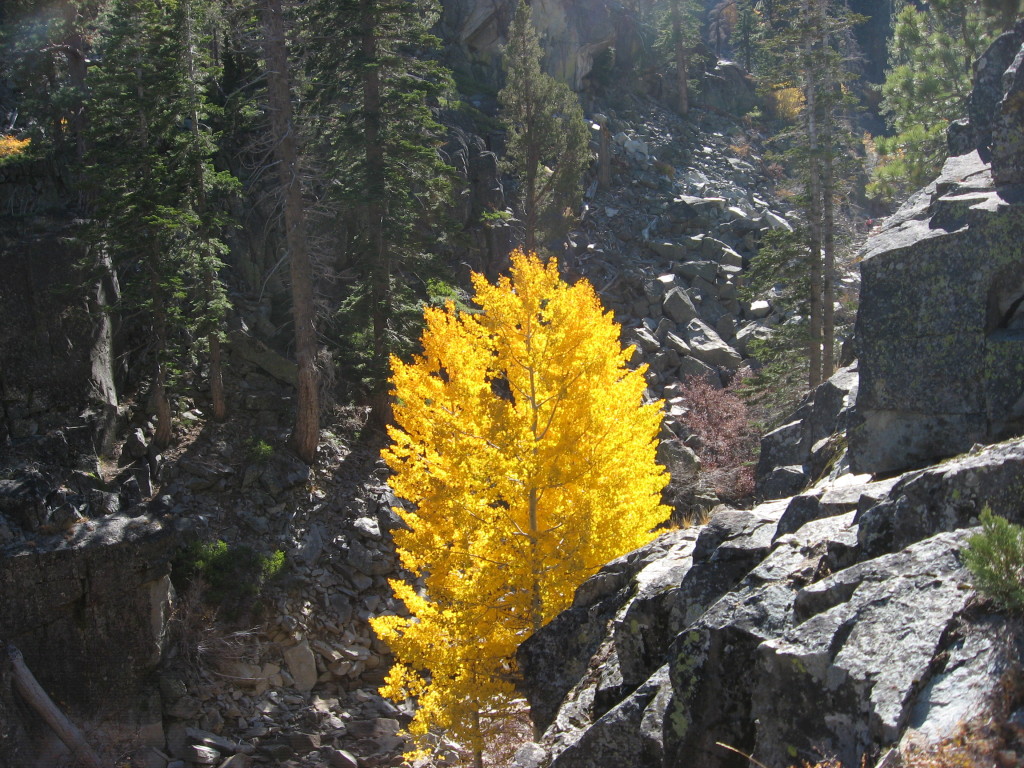
Quaking Aspen near Eagle Falls, Lake Tahoe, California
Two bright yellow aspens are ablaze along a trail leading to Eagle Falls in South Lake Tahoe. Ponderosa pines and rugged granite frame the brilliant colors of the Populus tremuloides in its radiant beauty.
Thick stands of aspens are common in moist meadows and near the lake in the Tahoe basin. But these two lone trees, with their long, smooth, pale-colored trunks, punctuate the mountainside and conifers like an incandescent exclamation mark.
Who can forget, “I think that I shall never see a poem as lovely as a tree”? American poet Joyce Kilmer’s Trees was the most memorized and recited poem in schools for decades after it first appeared in the August 1913 issue of Poetry magazine.
Trees capture our imagination. Aspens, with their rounded, almost heart-shaped leaves that flutter in the slightest breeze, can stop us in our busy tracks.
The golden leaves signal the earth’s spin into the autumn season. They may remind us to slow down and appreciate the aspens at this wonderful time before the leaves drop in winter and rebud and flower in spring and summer.
“The tree is more than first a seed, then a stem, then a living trunk, and then dead timber. The tree is a slow, enduring force straining to win the sky.”
~Antoine de Saint-Exupéry, The Wisdom of the Sands, translated from French by Stuart Gilbert